Comments on Sterile Polygamy

I’m trying something new today. I find this article so valuable that I have copied the whole thing just so I can add my own comments. It will be easier for you to read in this Substack than by following this link.
I’m doing this using a technique that I find valuable, but regarding which nobody has ever asked me how I do it. I think it is useful. Write if you are curious. In any case, my comments are set off by purple lines within the text that I copied.
Graham
Sterile Polygamy
The mating system we accidentally built

You may not have noticed, but we’ve invented a new mating system. It has the sexual inequality of polygamy with fertility closer to a celibate religious order. The harem without the children. The monastery without the prayers.
I describe the old paradigm, under which I grew up in the 1950s, in this short speech.
No one announced this revolution. There was no manifesto, no movement, no moment when the old order ended and the new one began. The Pill arrived. Women entered the workforce. Divorce was destigmatized. Dating apps were launched. Each change seemed incremental and was framed as expanding freedom, which it did. But the cumulative effect was far from positive. We still use the old words — marriage, dating, relationship — the way Russians kept calling their country the Soviet Union for months after it had ceased to exist.
The pill arrived in 1961. No Fault divorce was new when I got one in the 1970s.
Dating sites arrived with dial-up email connections in the 1980s. The Internet has continually improved them.
In the 2005 film Pride and Prejudice, Charlotte Lucas defends her decision to marry the buffoonish Mr. Collins:
Not all of us can afford to be romantic. I’m 27 years old. I’ve no money and no prospects. I’m already a burden to my parents. And I’m frightened. So don’t judge me, Lizzie. Don’t you dare judge me.
This sentiment feels alien today. A 27-year-old woman “frightened” about her marriage prospects? The desperation of Charlotte Lucas belongs to a world so distant it might as well be fantasy.
But these pressures existed until yesterday, historically speaking. And not only for women. As late as the 1950s, an unmarried man would be passed over for promotion. Such a man was seen as unstable, unserious. Then there was the most powerful incentive of all: sex. For most of history, premarital sex was genuinely difficult to obtain. Women who had it faced social ruin. Men who wanted regular access had one reliable path: marriage. Women traded sexual access for commitment. Men traded commitment for sexual access. Neither side could easily defect.
Almost all us guys were virgins when I graduated from high school in 1960. There were few if any among the graduates when my first family left school in the early 2000s.
The Pill broke the incentives driving these cultural institutions. Now, sex could be reliably separated from reproduction. The downstream cultural attitudes survived, mostly, for another generation or so. They’re now passing away.
In the early 1960s, we saw the pill as magic. We had no idea how those hormones would affect women’s behavior or health.
Marriage has become optional in a way it never was before. This is genuine progress — I wouldn’t suggest returning to a world where women needed husbands to survive. The freedoms are real and worth having. But a system can be freer and also more fragile. The question isn’t whether the old constraints were good. It’s whether the new equilibrium can sustain itself.
Throughout evolutionary history, women had had to look to men for protection and sustenance. They evolved to charm, wheedle, beg and connive to get what they and their children needed. They had not evolved to be in charge of their own lives, and certainly not to run society.
Compare Charlotte to a woman writing in TIME magazine in 2019. She’s a surgeon, 38 years old, sitting in a fertility clinic for an egg-freezing consultation. “I have prioritized my career over my personal life,” she writes, “and when I was younger, this tradeoff felt worth it.” She’d spent her twenties and early thirties in training. Now multiple doctors have told her the same thing: she waited too long. Her chances of having a biological child are “pretty low.”
See above.
Charlotte Lucas was frightened at 27 because she had to marry. The surgeon is frightened at 38 because she didn’t. Two centuries apart, same fear, opposite causes. We solved Charlotte’s problem. We created the surgeon’s.
But the surgeon’s dilemma is a symptom, not the disease. Something structural has shifted — something driving the sexlessness epidemic, the gender wars, the ideological chasm now splitting young men and women into opposing political tribes, the collapse in fertility that mathematically ends a society. We built a new mating system. But we didn’t realize what it would cost.
A global unraveling
In the United States, the share of young adults aged 18-29 reporting no sex in the past year doubled between 2010 and 2024 — from 12% to 24%. The increase was driven by men. At the 2018 peak, 28% of men under 30 reported no sex in the past year, compared to 18% of women.
On dating apps, women’s average match rate is 31%; men’s is 2.6% — a 12-fold difference. The most desirable men receive overwhelming attention while the majority receive almost nothing.
Yet, it brings no happiness. My daughter, who died three years ago at 39, found sex through Tinder. But her marriage choices were terrible.
In South Korea, the 4B movement (no dating, no sex, no marriage, no childbirth) has contributed to the lowest fertility rate ever recorded: 0.72 children per woman. Deaths outnumber births. In Japan, 40% of never-married adults aged 18-34 have never had sex. The population is projected to fall from 124 million to 87 million by 2070.
East Asians evolved high intelligence, high levels of cooperation, a high sense of obligation to family and society, but low levels of testosterone. When traditional societal structure dissolved, so did the impetus to marry and have children.
If you’re older than 45, you likely live in a world where people still got married. The figures above may feel like dispatches from another planet. They’re not. They’re dispatches from the other half of your own country. Among women born in 1980, 71% of college graduates were married by 45. Among those without degrees, it was only 52%. Marriage has become a luxury good. And all groups are converging toward the same destination: below replacement fertility.
My much younger wife chose me precisely because I am a guy who was raised to be married. See the first link above to a video describing it.
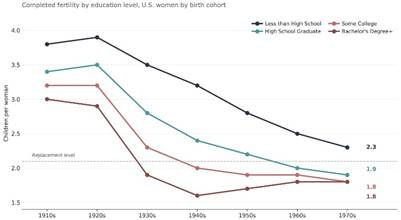
Author’s analysis, based on data from Pew Research, CDC, Hudde & Cohen and the GSS.
The delay that destroys fertility
Even among people who eventually marry, the delay itself has substantially reduced childbearing. In 1960, median age at first marriage was 20 for women. By 2023, it was 28 — an eight-year increase.
Most members of my 1960 high school class are now grandparents and great-grandparents. Those of us who went to college were swept up in the sexual revolution.
Biology hasn’t changed. A woman marrying at 20 had fifteen fertile years ahead. A woman marrying at 29 has perhaps six to ten, with fertility declining sharply after 35. Dating apps extend the search; career investment pushes marriage back; each year lost is fertility lost. IVF clinics are full of women who assumed they had more time.
Births happen within durable, socially enforced pair-bonds, not serial relationships with zero exit costs. Marriage and all that it entails — shared finances, legal ties, social expectations — makes the enormous investment of raising children viable. Serial dating has no lock-in. Either party can exit at any time. Without that commitment structure, neither side has an incentive to make the sacrifices that children require. When you can get sex without marriage, and marriage without urgency, you delay.
This describes my adult children’s situation in the US, and, I fear, that of young people I know in Ukraine. My challenge is to raise my young family in the expectation that they will marry.
Consider the following. Of the 0.86 child decline in American fertility since 1970, delayed marriage may account for 47%.1 Never marrying may account for 29%. And married couples having fewer children? Just 24%. The collapse isn’t about family size preferences. It’s about families not forming in the first place. This finding isn’t unique to the US. Across many developed nations, the same pattern holds.
The author writes later about us WEIRD people. There is a demographic angle that he is too PC to mention. Those most likely to be woke – college educated traditional Americans – are most affected.
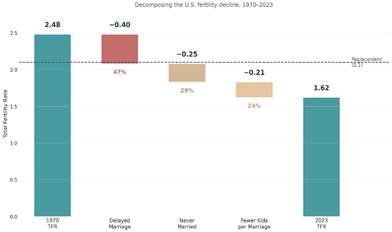
Author’s analysis, based on data from the Census Bureau, CDC and Pew Research.
In Japan, the total fertility rate fell from 2.1 to 1.2 — but marital fertility has remained stable at approximately 2.1. South Korea tells the same story: marriage age rose six years in three decades, the never-married rate at 40 jumped from near-zero to 18%, and TFR collapsed to 0.72 — the lowest ever recorded. Germany, with a TFR of less than 1.4, matches the pattern too. Married couples still have children. The problem is that fewer people are getting married, and those who do are marrying late.

Author’s analysis, based on data from Census Bureau, Destatis, IPSS, Statistics Korea, Pew Research, OECD Family Database and IMF Staff Report 2024
This has happened before
This may not be the first time a civilization has run into the problem of weakened norms of pair-bonding combined with (apparently) effective contraception. The Romans had their own version of the Pill: Silphium, a plant from the Libyan coast, was believed to be an effective contraceptive. (The historical analog isn’t perfect, as Roman silphium was so expensive it was limited to the elite class of Rome.)
Still, birth rates among the senatorial class declined so sharply that they could no longer sustain their own population. Senators chose to remain unmarried; those who did marry avoided having children. It preserved their wealth, limited entanglements and gave them freedom. Emperor Augustus responded with legislation: the Lex Julia in 18 BC and the Lex Papia Poppaea in 9 AD encouraged citizens to marry and have children. Unmarried men couldn’t inherit property or attend public games. The childless could only inherit half their bequests. Women who bore three or more children received legal privileges. Adultery became a public crime.
The irony was not lost on contemporaries. The Lex Papia Poppaea was proposed by two consuls, Marcus Papius Mutilus and Quintus Poppaeus Secundus, both of whom were unmarried and childless. The law encouraging Romans to have children was sponsored by men who refused to do so themselves.
The laws were deeply unpopular. Roman elites found loopholes and staged sham marriages. Marriage and birth rates among the elite did not rise significantly. Augustus had to banish his own daughter Julia for adultery, and later his granddaughter too. The quick legislative fix failed.
Silphium was expensive, so only the elite could afford it. Moreover, they had harvested it to extinction by the first century AD. The last stalk was apparently given to Emperor Nero.
Yet Rome did not go extinct. While senators avoided children, slaves, freedmen and provincials kept having them. The elite was eventually replaced: Tenney Frank’s analysis of 14,000 burial inscriptions found that by the Imperial period, a large fraction of Rome’s population descended from freedmen. These individuals learned Latin, adopted Roman law and worshipped Roman gods. Elite replacement with cultural continuity.
The same will not happen today. Contraception is no longer a luxury good. The lifestyles that once required senatorial wealth — delayed marriage, serial relationships, voluntary childlessness — are now available to anyone with a smartphone. The fertility collapse isn’t confined to an elite that can be replaced from below. It’s universal among everyone who participates in the modern mating market.
The mating market is different in different countries. Note American and Western European interest in foreign brides. Our Ukrainian girls are by and large more marriageable. Their chief problem is not enough men who are interested, sober, and solvent. And not in the army.
Where did monogamy come from?
If monogamy runs against the interests of the powerful, and even draconian laws from a god-emperor do not change behavior, how did the West end up with near-universal monogamy? The answer is a thousand-year social engineering project by the Christian Church.
Joseph Henrich’s The WEIRDest People in the World documents this transformation in detail. The Church’s “Marriage and Family Programme” systematically dismantled the kin-based structures that supported polygyny. The Programme banned cousin marriage out to sixth cousins, breaking up the tight clan networks that had organized society. It prohibited not only polygyny itself, but also concubinage and divorce. It required consent from both bride and groom, undermining arranged marriages that served family interests.
The Programme was strictly enforced. Kings were excommunicated for taking second wives. Nobles were denied church burial for keeping concubines. Communities were mobilized to report violations. No one was exempt.
The effects were profound. As clans dissolved, people had to form relationships beyond their kin. This created what Henrich calls “WEIRD” psychology: individualistic, guilt- rather than shame-based, high in impersonal trust and oriented toward abstract principles. The historian David Herlihy has described the Programme as “a great social achievement of the early Middle Ages”, since it enforced the same rules of sexual conduct for rich and poor alike.
I largely agree. See my review of The WEIRDest People in the World
Monogamy proved advantageous in competition with other societies. Monogamous societies had lower male violence, broader trust networks, and more investment in children. They out-competed polygamous ones. By the 20th century, formal monogamy had spread globally — not because it comes naturally to humans, but because the societies that practiced it dominated.
This makes sense from a game theoretic perspective: monogamy benefits society but runs against the interests of those with power to defect. High-status men benefit from polygyny. Women may even prefer to share a high-status man over exclusive access to a low-status one. The incentives favour defection. Maintaining monogamy requires external enforcement.
How we got here
In 2012, Tinder launched with a simple innovation: the swipe. Left for no, right for yes. The interface was deliberately game-like — the same variable reward mechanism that makes slot machines addictive. Within two years, the app was processing a billion swipes per day.
The designers had built something more consequential than they knew. Before Tinder, you met partners primarily through work, church and friends. You screened maybe fifty or a hundred realistic candidates over the course of your twenties. And there were still social costs attached to promiscuity.
Tinder changed things. Suddenly women had access to every male user within a fifty-mile radius — thousands of candidates, sorted by attractiveness, available for private evaluation, with zero social cost. And here’s the thing about this kind of rating system: the same people rise to the top.
The data is stark. Analysis of dating app behavior shows that women like about 14% of male profiles, whereas men like 46% of female profiles. The result is that a small percentage of men receive the vast majority of female attention. The top 10% of men get over half of all likes. The bottom 50% of men get about 5%.
The word that characterizes it is hypergamy. Women evolved to seek the most successful mates, but monogamous Christian society pushed them to marry the Mr. Collins’ of the world.
Technology alone didn’t create this situation. It just removed the last constraint on a system that had been eroding for decades. Women’s economic independence removed the material need for marriage — a woman with a career doesn’t need a husband for survival. The collapse of institutional enforcement removed the cultural pressure. Church attendance fell, divorce was destigmatized, cohabitation became routine and premarital sex universal. Dating apps were the final blow: a technology that made the new equilibrium visible.
If you designed a system to maximize sexual access for high-status men while maintaining the pretense of monogamy, you couldn’t do better than the one we’ve built by accident.
Also note that many high-status men are not interested. Peter Thiel, Tim Cook and many others are gay, and even more simply not interested in marriage.
The worst of both worlds
Traditional polygamy at least maintained fertility. A chief with five wives sired twenty children. Solomon had 700 wives. The Ottoman sultans populated entire empires. Childbearing was the point.
We’ve invented something different: effective polygamy without children. High-status men cycle through partners, but nobody reproduces. Why? Because reproduction requires the lock-in that marriage provides. Serial dating offers men all the benefits of access with none of the costs of commitment. And women, waiting for commitment from men who have no incentive to provide it, delay childbearing until it’s too late.
No one aside from the deeply religious would argue that we should eliminate contraception and go back to shotgun weddings. Yet cultures face an ultimate test that doesn’t care about our preferences: reproduction. A culture that doesn’t reproduce won’t exist. At a TFR of 0.72, South Korea is losing more than half its population every generation. There will be practically no South Koreans left within a few generations. Similar math applies to Japan, Southern Europe, and many Western countries.
Immigration is not a solution. Immigrants invariably converge to host-country fertility rates within a generation or two. They only maintain high fertility if they resist assimilation. The moment they adopt Western norms, they adopt Western fertility behavior too. The only communities maintaining high fertility are those that embrace traditional religions: the Amish, the ultra-Orthodox, and some Muslim groups. The future therefore belongs to the unassimilated. It will not be populated by those who subscribe to mainstream Western culture.
Also, we want a society of people who will assimilate, who will be like us traditional Americans. Those with high fertility backgrounds – Africans and Muslims – have steadfastly refused to do so in Europe.
Technology may provide an escape route — artificial wombs, dramatically extended female fertility, or some other innovation we can’t yet imagine. But there’s no guarantee. And we’re facing the problem right now.
In No Country for Old Men, Anton Chigurh asks: “If the rule you followed brought you to this, of what use was the rule?” We followed certain rules: individual freedom; romantic love as the basis for marriage; the right to delay childbearing; the dissolution of social pressures that channeled people toward family formation. But they are what brought us here: to a mating system selecting itself out of existence.
In a sense, this problem will solve itself. The human race will continue — the only question is which humans. If we want the answer to include societies that value individual liberty, secular governance and equality before the law, we need to make those societies compatible with having children.
Some minority within our society will perpetuate itself. See Edward Dutton’s Woke Eugenics.
I visited the website and commented the following there:
It seems to me you missed your own point.
You point out how successful the Amish are, for example. Yet credit their ability for higher fertility rates with minimized delay in marriage instead of what appears to be the TRUE original source-- Christian society maximizing the patriarchal family.
One more thing that appears to miss the point: the apparent progressive event that was catalyzed by many things in the beginning of the 20th century and resulted in exponential movement of children FAR from their homes at the height of fertility-- College education.
My parents four sons ALL moved far away from the hometown during the 70's as we matriculated while our classmates staying around after HS stuck close to home. Guess who had more kids?
I believe that you, like many scientists/ researchers, in error stop too soon looking for origins of a problem. You stopped at: Delay of marriage but should have continued looking for WHAT delayed marriage.
Having a Christian based and family based family unit is likely a key solution to low fertility.
Having localized industry, localized manufacturing and educational facilities locally will reinforce the family unit to the extent that offspring can feel confident they can have a family and stay close to those they know and love most.
By the way. . . I looked for your comments about this article, here, and did not find any. . .
Did I miss something?
They do have artificial insemination and women can pick the potential father. There was an article somewhere about 10 years ago on a guy who graduated from Stanford with a BA in Fine Arts. He was also attractive. But poor. He sold his sperm and fathered around 40 kids, mostly from hispanic women wanting to have whiter kids. The kids are now in their 30s and one even went to live with the guy (as his son of course - nothing flakey).
I also believe I have read somewhere that women who graduate from Ivy League schools are more successful in getting married and maintaining the marriage whereas state school graduates and below have a lower success rate.
I would think the more successful classes would have higher quality kids while lower classes less so, e.g., non-white, drugs, divorce, anti-social behavior, etc. Which would accelerate class/caste differences.
My impression is that modern liberalism has created a huge class of victims now well into their 30s and younger. They may have legitimate traumas or not. But trauma victimhood is their chief identity. Add on AI and smartphone addiction and it looks pretty grime.