Investigating Project Zimbabwe
20250119

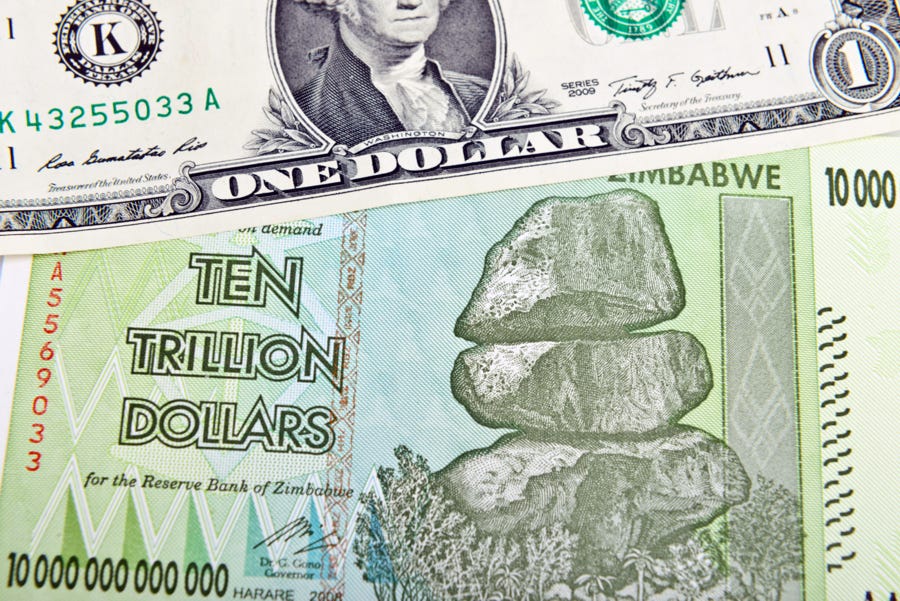
Quoth the Raven has some interesting friends. I love this piece on Trading Project Zimbabwe from the middle of Covid. I steal his graphics to spice up this post.
And just for good measure, this venerable country and western song, Inflation or Deflation, by Singer/Economist Merle Hazard and his sidekick Bretton Woods, with the refrain “Zimbabwe or Japan?”
I have linked recently to QTR columns written by Harris Kupperman here, here and here. Reading them had me pull my 2010 “Little Book of Economics” by Greg Ip off the shelf to read again about the relationship among money supply, inflation and interest rates.
Vastly increasing the money supply leads to hyperinflation. However, per Ip, in the short run central banks usually adjust interest rates, thereby increasing or decreasing the demand for money. This in turn leads banks to increase or decrease money supply by increasing or decreasing demand for loans. Ip warns against doing just what has been done over the past decade, that is, government and central banks vastly increasing the money supply. He claims that the citizenry will not tolerate it. In that he appears to be wrong. Given a choice between inflation and austerity, we have pushed Obama, Trump, Biden and their Fed chairs to print money.
The standard solution when Latin American countries get into cycles of hyperinflation has been to dollarize. It worked for Ecuador and Argentina. Panama has always used the dollar. However, what’s to do when it is the dollar itself that needs to be rescued? No other world currency is big enough, and most of them are in even worse shape. The argument circles back to gold and Bitcoin. However, even at $17 trillion above ground, there is vastly too little gold to do the trick at anything near its current price.
Whatever they choose, how do you transition an entire economy from one currency to another? The only certainty is that there is no good answer. My bet is that whatever gets devised will involve some sort of central bank digital currency, depriving the citizenry of their financial freedom and privacy. Perhaps fleecing them a bit in the process. Seems to me that having a bit of gold and crypto on the side will not be a bad idea.
What happens to the stock market when inflation takes off? The last of the four Kupperman links above describes what is happening in Brazil and Turkey, which have been seeing high levels of inflation. The major stocks on their exchanges are vastly cheaper than those in the S&P, trading at PE multiples of 3 and 4.
Kupperman expects the reader to understand why that would be. I haven’t read a reason anywhere, but I assume the logic would be something like this. Interest rates have to rise more or less in tandem with inflation, to keep loan supply and demand in balance. Equities, because they involve more risk, must trade at a premium to fixed rate instruments. To offer a superior return on investment to bank deposits, stocks have to trade at low PEs. Somebody please provide a comment to correct me. Meanwhile, I’m reading Kupperman’s recommended 90-year-old “Economics of Inflation,” written in the aftermath of the Weimar inflation of the 1920s. It’s ten dollars on Kindle; must still have something to say.
In my investigation of South America as a place to bug out, I had discovered that Petrobras was selling at less than 4x earnings. Many other overseas petroleum companies were similarly cheap.
An investment in 30% bonds denominated in Brazilian Reals would provide diminishing returns, as each year’s yield was decreased by inflation. On the other hand, one would think that an equity investment would appreciate with inflation. Petrobras’ plant and equipment will rise in value with inflation. One would assume that if their margins remain stable, income would likewise go up with inflation. If that is true, a 4x PE might be a pretty good deal. Again, it will take some reading. And advise from outside.
I note that my investment in Ukraine’s Myronovsky Hliboprodukt, MHCP, is up a bit. It has a similarly low PE, and should be subject to the same logic as above. I need to read the annual reports to figure it out.
That’s the news from Lake WeBeGone, where the strong man is recovering from a week-long cold. The kids are back in school. Putin is blowing rockets our way every day, not doing great damage that I notice but reminding us that he is there. And, one would hope, making it clear to Trump what an SOB he truly is. I’m paying more attention to bloggers like The Russian Dude and Jake Broe with their analysis of Russia’s internal dynamics than I am to the frontline news.
If Trump is able to accomplish half the things he wants to do it’s possible that the US could be at the beginning of a tech surge, and possibly other sectors as well. He’s going to have to eliminate or seriously cripple DEI, ESG and BDS for one thing. But he’s getting off to an encouraging start.
There will be lawsuits using “disparate impact” arguments as the means to stop the move to more efficiency and competitiveness. There may be hundreds, I don’t know, but I do know there will be relentless opposition. There’s also the problem of bringing in cheaper tech workers which seems necessary in order to compete, but is facing widespread pushback.
If one is optimistic and can invest in US brokerages you could buy 3x bull tech funds TECL and TQQQ. They have consistently returned over 40% annually (minus a negative 2022) for the past 5 years or so. I’ve owned them for 5 years and have made a lot of money by just holding and selling half my holdings after they become too big of a percent of my portfolio. But, it takes a strong stomach to weather the market downturns.
You might consider investing in a fund rather than an individual company and let the pros figure all this out.