Beyond Inheritance – Our Ever-mutating cells and a new understanding of health. Roxanne Khamsi
20260508

Our DNA is not stable over a lifetime. The same mechanisms that have long been known to cause mutations in our germ cells – our sperm and eggs – affect every part of the body. In fact, they affect just about everything else more than our reproductive system.
It has long been known that cancer is caused by unchecked cell division. Most death from cancer is ultimately rather mechanical. Uncontrolled reproduction of the cancer cells causes growth that crowds out healthy tissue, leaving too few to operate or too little room for them to survive.
The cells within our bodies continue to duplicate over the course of our lives. Stem cells, for instance, generate red blood cells, which have a lifetime measured in weeks. Skin cells likewise have short lives, while others such as nerve cells may never divide. Since every cell in our bodies is exposed to radiation and harmful chemicals at some level, they are all subject to mutation. The miracle is that there is not more – Khamsi’s book describes the mechanisms of repairing cells and killing off dangerous mutants. Nonetheless, mutations happen.
Intestines are lined with clusters of cells called crypts, each hived off of a single stem cell. As those stem cells incur mutations, all cells in the crypt follow. Scientists have developed techniques that allow them to analyze and compare the DNA in individual cells. Analyzing the aggregate in crypt cells over an animal’s lifetime, they conclude that every mammal will experience something like 3200 mutations over the course of a lifetime.
Those lifetimes vary widely, from three years for a mouse to 230 for the bowhead whale. Khamsi has a lot to say about the different species’ protection and repair mechanisms, and how they may lead to a fountain of youth.
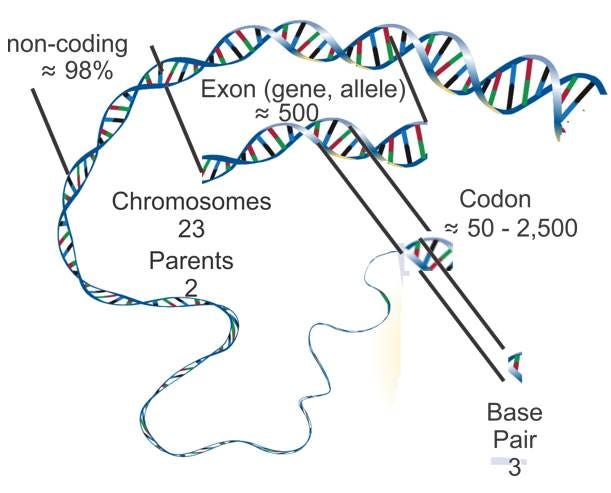
It is worth a note about what mutations are. Human DNA consists of 46 chromosomes, 23 from each parent.
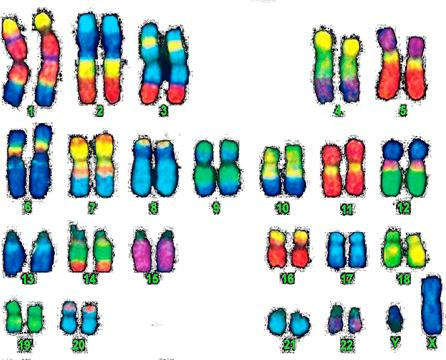
Each chromosome carries multiple exons, also called genes or alleles. There are 20,000 - 23,000 in all. Dividing, that works out to an average of 500 per double-helix chromosome.
The links in the double helix are called base pairs. There are four possible nucleotide bases, adenine, guanine, cytosine and thiamine, each of which will pair with a single given base on the other chain. There are thus four possible combinations of each base pair. Three base pairs make a codon. Only twenty of the 64 possible combinations are used, each instructing the DNA to make one kind of amino acid. Other combinations are punctuation, two being “gene starts here” and “gene ends here.”
A mutation is a change in one base pair. Of the six billion base pairs among the 23 chromosomes, more than 99% are the same throughout a species. The rest express our individuality. At birth, closely related people – neighbors in a village – will probably differ by about 4 million base pairs.
Mutations affect more than just our somatic (body) and germ (reproductive) cells. Our bodies are made up of 30 to 40 trillion of our own cells. Living within them are an equal number of free-living symbiotic cells that we need for digestion and other metabolic functions. These too can and do mutate.
Khamsi has lengthy discussions of the problems that can arise when mutants appear in either the body or the symbiotic cells. But there are also many instances in which their mutations are beneficial. The antibodies in our immune systems, for instance, arise out of spontaneous mutations when diseases are present. The plethora of varieties means that some will prove especially effective in fighting one particular pathogen. Our bodies have a mechanism to select and clone that particular mutation, providing us with antibodies to fight that same infection when it recurs.
Pathogens also mutate. Stomach bacteria Heliobacter Pylori, for instance, can remain with us for years, mutating as required to overcome whatever medicines we take to get rid of it.
Khamsi holds very establishment views on medicines. She has nothing but kind words for most medicines and vaccines. Other books, reviews of which appear on this platform, have different takes. Below are some instances, Khamsi’s view in standard text, alternative in italics.
Polio
The polio virus mutates and becomes more virulent within its host. Attempt to eradicate polio has been largely effective
In The Moth in the Machine, Forrest Maready notes that Polio is an endemic stomach virus. It is dangerous when it invades the spine, which it can because of a leaky gut and proximity of the intestines to spine in children.
Autism
Somatic mutations contribute to the rise in the incidence of autism.
Vaccine injury is mostly responsible for the increase in autism, though the diagnosis is vague and there are many causes. See Paul Thomas’ Vax Facts. Researcher Toby Rogers puts the fraction of autism attributable to vaccines at about 75%
AIDS
Khamsi discusses the mutating HIV virus, on the assumption that various of its mutations facilitate different expressions of the AIDS condition. Field work was done in Africa
Celia Farber and Peter Duisberg note that although HIV is widespread in Africa, AIDS is not. The expected epidemic never arrived. In fact, it appears to be a lifestyle disease largely confined to male homosexuals and IV drug users.
Covid
Khamsi’s thesis is that more boosters provided better defense against Covid, by providing immunity to more mutations. She writes
Frauke Mücksch, a postdoctoral scientist in a collaborating Rockefeller lab who was heavily involved in carrying out the experiment, felt reassured by the data. “I was just really relieved. I thought, ‘Oh, my God—good,’ ” she says. “I think we all just wanted to share how great the booster is. I definitely told my family ‘Get this booster. It’s important for sure.’
Other writers, too many to mention, believe that the vaccines lead to original antigenic sin. “Original antigenic sin is the immune system’s preference for previous infections over new variants of a pathogen. It affects antibody and T-cell responses to influenza, dengue, HIV, SARS-CoV-2 and other viruses.”
Fighting the last war, via injected or self-generated antibodies from mRNA vaccines, is worse than letting a naïve immune system figure out new ones on its own.
The book has many strengths. Khamsi has personal stories about many researchers and disease subjects. The book has a fantastic bibliography and a good index. It is highly informative about the state-of-the-art in genetic research, which at this point is about the same as mutation research.